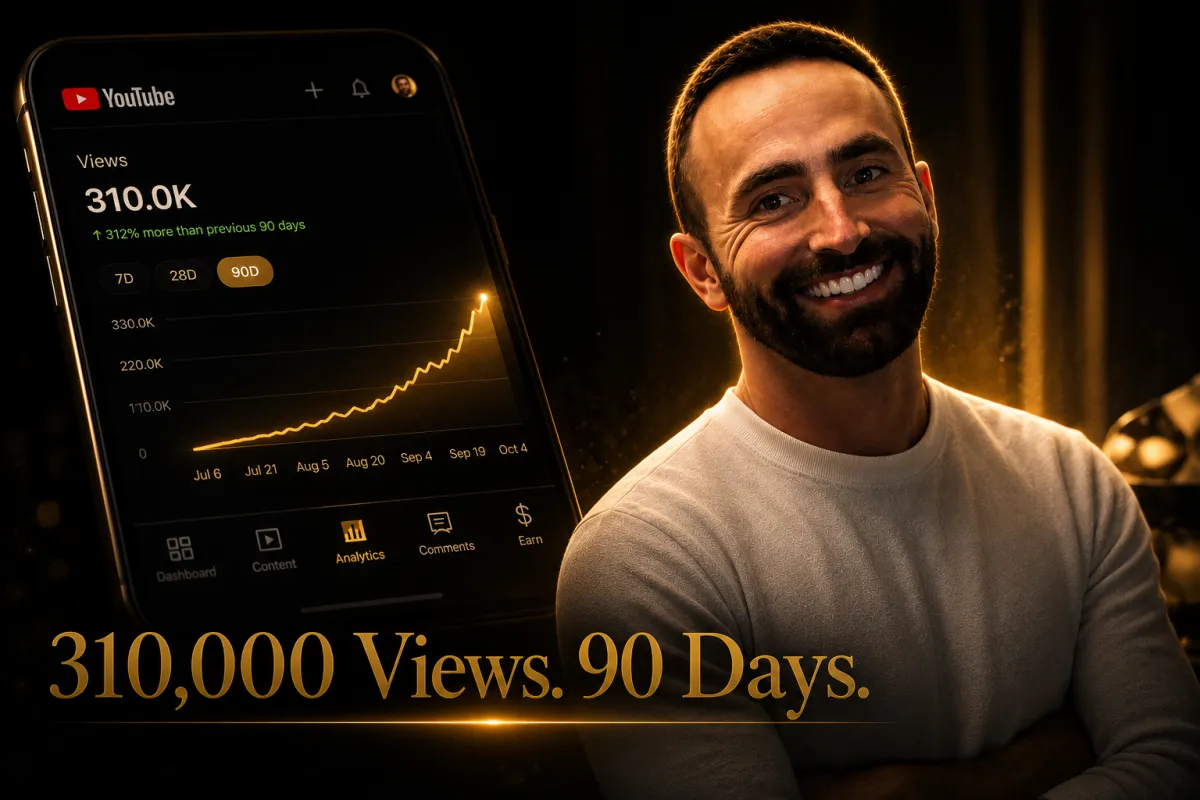
The YouTube Strategy That Took My Client from 0 to 310,000 Views in 90 Days (And What Most Coaches Get Dead Wrong)
Most coaches who come to me with a YouTube problem don't actually have a YouTube problem.
They have a positioning problem. A consistency problem. Or most often, a patience problem dressed up as a strategy problem.
But Mason's situation was different.
When Mason started working with us at Ascend Media, he wasn't starting from zero in the way most people mean it. He had a clear offer, a real track record with clients, and something to say. What he didn't have was a system. He was posting when he had time, which meant he wasn't really posting at all. His videos were decent but scattered. His thumbnails weren't built for click-through. His titles weren't built for search. And nothing, not a single video, was connected to a clear next step for the viewer.
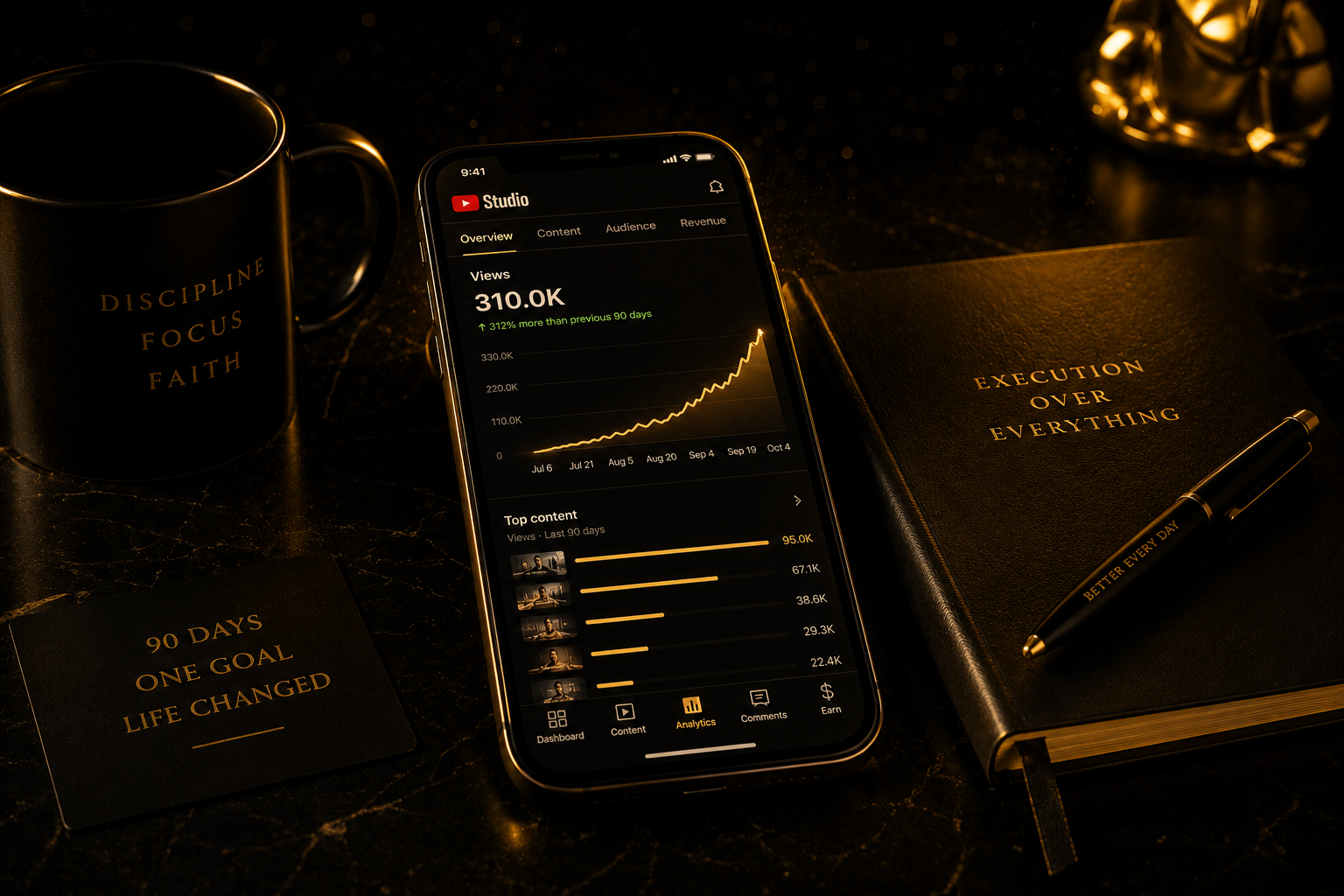
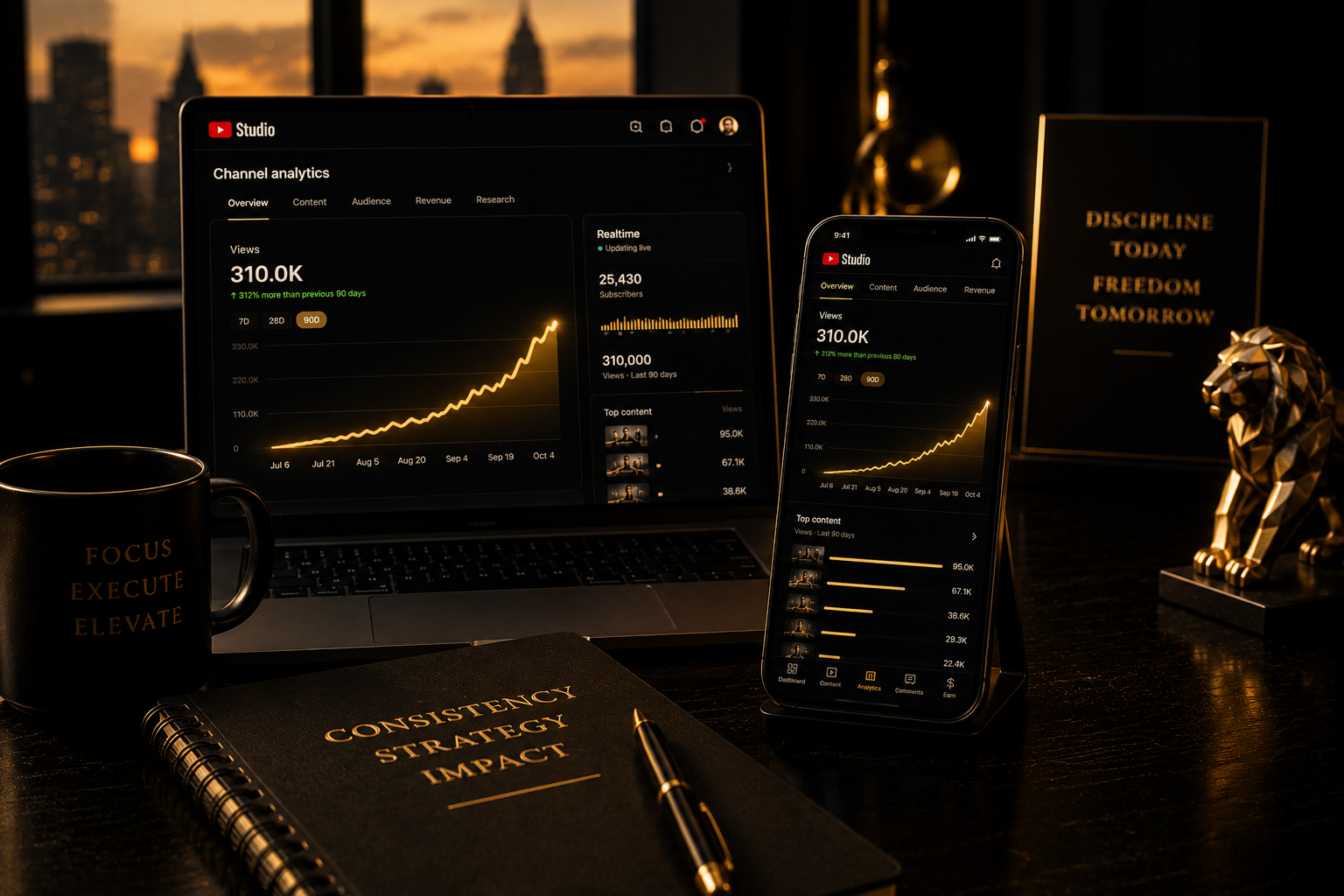
Ninety days later: 310,000 views. Not viral luck. Not one video that skewed the numbers. Consistent, compounding traction across a body of work that was finally pointing in the same direction.
Here's what actually moved the needle.
The Single-Channel Focus
The first thing we did was simplify. Mason had ideas about Shorts, about repurposing, about being everywhere. We shelved all of it. One channel. One content lane. One audience.
YouTube rewards depth of relevance, not breadth of output. The algorithm wants to understand what your channel is about so it knows who to show it to. When you're inconsistent in your content lane, you're training it to be confused about you.
We picked his lane based on three criteria: what he knows cold, what his ideal client is actively searching for, and what no one in his niche was saying the way he could say it.
YouTube is not short on content. It is very short on perspective.
Your job is not to cover a topic. Your job is to own an angle. That's the difference between a YouTube channel that grows and one that stalls.
Keyword-First, Not Idea-First
This is where most coaches lose the game before they start. They think of a topic they want to talk about, record it, post it, and wonder why no one watches.
YouTube is a search engine before it's a social platform. If you're not building your video concepts around terms people are actually typing into that search bar, you're making content for yourself.
We did real keyword research, not guesses, not vibes. We looked at search volume, competition density, and what the top-ranking videos were missing. Then we built Mason's editorial calendar entirely around those gaps. Every video title was a search query someone was already asking. Every thumbnail was built to answer that query visually before the viewer even clicked.
The result is that his videos didn't just get views. they got the right views. People who were already looking for what he offers.
The Architecture of a Watchable Video
Here's something that's hard to hear if you've been doing this a while: most coaching content is boring to watch. Not because the coach is boring. Because the video isn't structured to hold attention in 2026.
Every video we produce for Ascend clients follows a tight architecture. Hook in the first eight seconds, not a slow intro, not "welcome back to the channel." A hook. A tension. A reason to stay. Then a rapid re-hook at the 30-second mark. Then the body, broken into short punchy segments. Then a close that drives action.
Mason stopped recording long, wandering videos that felt like a webinar and started recording focused, tight pieces that respected the viewer's time.
Viewers stayed longer. Longer watch time told YouTube the video was worth promoting. YouTube promoted it. More people watched. Compound.
Shorts as a Distribution Layer, Not a Content Strategy
We did use Shorts but not the way most people use them. Shorts are not where you build authority. They are where you get found. We clipped the highest-value moments from Mason's long-form videos, captioned them for silent watching, and used them to pull viewers back to the main channel.
Shorts alone don't convert. Shorts that point somewhere do.
What Most Coaches Get Wrong
They treat YouTube like a megaphone when it's actually a magnet. A megaphone pushes your message out. A magnet pulls the right people in. The difference is intention. Megaphone content says "here's what I want to say." Magnet content says "here's what you've been searching for."
They also underestimate the timeline. Ninety days sounds fast..and it is, with the right system behind it. But most coaches quit at week six because they're not seeing results on their arbitrary timeline. The coaches who win on YouTube are the ones who commit to the long game with a short-game system.
If your YouTube channel is inconsistent, scattered, or just not converting, the problem is rarely talent. It's almost always system. That's what we build at Ascend Media. Done for you, so you can focus on being the expert on camera while we handle everything else.
Ready to turn your channel into a client acquisition machine?
Apply Here for more info


